Mastering Leash Reactivity: A Comprehensive 2026 Guide for Dog Owners
Walking your dog should be a joyful experience, a time for bonding and exercise. However, for many dog owners, it can be a source of stress and embarrassment, all thanks to a common behavioral challenge: dog leash reactivity. If your dog barks, lunges, growls, or pulls excessively at the sight of other dogs, people, or even inanimate objects while on leash, you’re not alone. This behavior, often misunderstood as aggression, is more frequently rooted in fear, frustration, or over-excitement.
In this comprehensive 2026 guide, we’ll dive deep into understanding dog leash reactivity, exploring its causes, and, most importantly, providing you with practical, step-by-step solutions to help your dog become a calmer, more confident companion on walks. We’ll cover everything from identifying triggers and choosing the right equipment to implementing effective training techniques and maintaining progress. Get ready to transform your walking experience and strengthen the bond with your furry friend.
What Exactly is Dog Leash Reactivity?
Before we can tackle dog leash reactivity, it’s crucial to understand what it is and what it isn’t. Leash reactivity describes a dog’s over-the-top response to specific stimuli when on a leash. This response is typically characterized by barking, lunging, growling, whining, or frantic pulling. It’s often mistaken for aggression, but in many cases, it’s a manifestation of a dog’s inability to cope with a situation, especially when they feel trapped or restricted by the leash.
Common triggers include:
- Other dogs: The most frequent trigger, often driven by frustration from not being able to greet, or fear.
- People: Especially strangers, children, or people wearing hats/hoods.
- Moving objects: Bicycles, skateboards, cars, or even squirrels.
- Sounds: Loud noises, construction, or even distant dog barks.
It’s important to differentiate reactivity from true aggression. While a reactive dog might appear aggressive, their underlying motivation is often fear or anxiety, leading to a ‘fight or flight’ response. Because they are on a leash, ‘flight’ isn’t an option, so they resort to ‘fight’ (barking, lunging) to make the scary thing go away. Understanding this distinction is the first step towards effective management and training for dog leash reactivity.
Why Does My Dog Exhibit Leash Reactivity? Understanding the Root Causes
Unraveling the ‘why’ behind your dog’s reactive behavior is paramount to finding the right solutions. Dog leash reactivity is rarely a simple issue; it’s often a complex interplay of genetics, early experiences, and environmental factors. Here are some of the most common root causes:
1. Fear and Anxiety
This is perhaps the most common driver of reactivity. A dog might be fearful of other dogs, people, or certain objects due to past negative experiences, lack of socialization, or a naturally timid temperament. When a fearful dog sees a trigger, they perceive it as a threat. Since the leash prevents them from escaping (flight), they resort to barking and lunging (fight) to create distance and make the perceived threat disappear.
2. Frustration (Barrier Frustration)
Some dogs are actually friendly and desperately want to greet other dogs or people, but the leash prevents them from doing so. This builds immense frustration, which then boils over into reactive displays. They might whine, pull, and bark because they can’t get to what they want. This is particularly common in highly social dogs who weren’t taught appropriate leash manners or greetings early on.
3. Over-Excitement and Lack of Impulse Control
For some dogs, especially adolescents or those with high energy, the sight of another dog or person simply overwhelms them with excitement. They lack the impulse control to manage this excitement calmly, leading to boisterous, often misinterpreted reactive behaviors. They might bark and pull because they’re simply too excited to contain themselves.
4. Insufficient Socialization
The critical socialization window for puppies is between 3 to 16 weeks. Dogs who miss out on varied, positive exposures to different sights, sounds, people, and other dogs during this period may grow up to be fearful or anxious in novel situations, contributing to dog leash reactivity.
5. Pain or Discomfort
Sometimes, what appears to be behavioral can have a physical root. A dog experiencing pain (e.g., joint pain, dental issues, neck pain from pulling) might become reactive as a way to avoid interaction or because they are generally more irritable. A vet check-up is always a good idea to rule out underlying medical conditions.
6. Genetics
Breed and individual genetics play a role. Some breeds are predisposed to being more vigilant, protective, or sensitive, which can contribute to reactive tendencies. However, genetics are rarely the sole cause; environment and training always play a significant part.
7. Inconsistent Training or Management
If a dog has learned that reactive behavior successfully makes triggers go away (e.g., the owner pulls them away, or the other dog/person moves on), they will continue the behavior because it’s reinforced. Inconsistent handling or the use of aversive tools that cause pain or fear can also exacerbate reactivity.
Understanding these underlying motivations is key. Once you pinpoint why your dog is reacting, you can tailor your approach to address the specific emotional state and needs of your dog, setting the stage for successful management of dog leash reactivity.
Essential Tools and Equipment for Managing Leash Reactivity
Having the right gear can make a significant difference in managing dog leash reactivity, providing you with better control and ensuring your dog’s comfort and safety. Avoid tools that cause pain or discomfort, as these can heighten anxiety and worsen reactivity in the long run.
1. Front-Clip Harnesses
A front-clip harness is often a game-changer for reactive dogs. Unlike back-clip harnesses or neck collars, when your dog pulls, the leash attachment on the chest redirects their momentum to the side, turning them towards you. This reduces pulling power and makes it easier to manage strong lunges without putting pressure on their neck. Look for harnesses that are well-padded and fit securely.
Recommended Brands: Freedom No-Pull Harness, Easy Walk Harness, Balance Harness.
2. Head Halters (Halti, Gentle Leader)
Head halters work similarly to a horse’s halter, giving you control over your dog’s head, and consequently, their body. When your dog tries to pull or lunge, the halter gently guides their head, making it difficult for them to generate force. They are excellent for strong pullers and provide precise control, but require a positive introduction and conditioning to ensure your dog accepts them comfortably.
Important: Never yank or pull on a head halter, as this can cause neck injury. Use gentle guidance.
3. Standard 6-Foot Leash
A sturdy, non-retractable 6-foot leash made of nylon or leather is ideal. This length provides enough slack for your dog to explore a bit without allowing too much distance, which is crucial for managing reactive situations. Retractable leashes are generally not recommended for reactive dogs as they offer inconsistent tension, can cause rope burns, and make it harder to maintain control in an emergency.
4. High-Value Treats
These are your secret weapon! For a reactive dog, ‘high-value’ means something truly irresistible – cooked chicken, cheese, hot dogs, liverwurst, or specialized training treats. These treats need to be far more appealing than the distraction itself to effectively redirect your dog’s attention and create positive associations. Carry a generous supply in a treat pouch.
5. Treat Pouch
A treat pouch allows for quick and easy access to rewards, which is essential for timing your positive reinforcement correctly. Look for one that clips to your waist or has a belt for comfort and accessibility.
6. Long Line (Optional, for controlled environments)
A long line (15-30 feet) can be useful for practicing recall and distance work in a safe, enclosed area away from triggers. It allows your dog more freedom to move while still maintaining a safety connection. This is not for walks where triggers are present, but for building confidence and obedience in a controlled setting.
What to Avoid:
- Choke chains, prong collars, and electronic collars: These tools work by causing pain or fear, which can increase your dog’s anxiety and aggression, worsening dog leash reactivity in the long run. They damage trust and do not address the underlying emotional state.
- Ret retractable leashes: As mentioned, they offer poor control and can be dangerous.
Choosing the right equipment is a foundational step. It ensures your dog’s safety and comfort while giving you the tools you need to effectively implement training strategies for dog leash reactivity.
Implementing a Management Plan: Preventing Reactivity Before it Starts
Before you even begin active training, an effective management plan is crucial. The goal of management is to prevent your dog from practicing reactive behaviors, thereby stopping the reinforcement cycle and reducing their overall stress. Every time your dog reacts, it strengthens the neural pathways associated with that behavior. By preventing reactions, you create opportunities for new, positive associations.
1. Identify and Avoid Triggers
This is the cornerstone of management. Keep a journal for a week or two, noting:
- When your dog reacts (time of day).
- Where your dog reacts (specific street, park, etc.).
- What triggers the reaction (type of dog, person, object).
- Distance at which they react (their ‘threshold’).
- Intensity of the reaction (mild whine vs. full-blown lunge).
Once you understand your dog’s triggers and threshold, you can actively avoid them. This might mean:
- Walking at different times of day (e.g., early morning or late evening).
- Choosing less-trafficked routes or quiet parks.
- Driving to a secluded area for walks.
- Crossing the street or turning around when you see a trigger approaching.
The aim is to keep your dog under their threshold, where they can still notice the trigger but not react. This is where learning can happen.
2. Create a Safe Zone: The ‘Bubble’
Imagine your dog has an invisible ‘bubble’ around them. When a trigger enters this bubble, your dog reacts. Your job is to keep triggers outside this bubble. This means increasing distance from triggers significantly. If your dog reacts at 50 feet, start training at 100 feet. Slowly, as they gain confidence and new associations, this bubble will shrink.
3. Use Appropriate Equipment Consistently
As discussed, a front-clip harness or head halter can provide better control. Ensure it’s fitted correctly and used consistently on every walk. This consistency helps your dog understand what to expect and reduces confusion.
4. Short, Successful Walks
Prioritize quality over quantity. Instead of long, stressful walks where your dog constantly reacts, opt for shorter, more frequent walks in low-trigger environments. The goal is for your dog to have successful, non-reactive outings, building their confidence and reducing their overall stress levels.
5. Exercise and Mental Stimulation
A tired dog is often a good dog. Ensure your dog is getting adequate physical exercise, but also plenty of mental stimulation. Puzzle toys, snuffle mats, scent work, and training sessions at home can help drain energy and provide an outlet for their minds, making them less prone to reactivity on walks. This is a vital component in reducing dog leash reactivity.
6. Advocate for Your Dog
Don’t be afraid to politely ask people to give you space. A simple ‘My dog is in training, please give us some room’ or ‘He’s not friendly’ (even if he is, it’s safer) can prevent unwanted interactions and keep your dog under their threshold. Your dog relies on you to manage their environment.
By diligently implementing these management strategies, you’re not just preventing reactive outbursts; you’re also setting the stage for successful behavior modification. This proactive approach is fundamental to addressing dog leash reactivity effectively.
Effective Training Techniques: Changing Your Dog’s Emotional Response
Once you’ve established a solid management plan, you can begin actively training your dog to change their emotional response to triggers. The goal is to transform negative associations (fear, frustration) into positive ones (calmness, focus on you). We use positive reinforcement techniques, specifically classical conditioning and operant conditioning.
1. Counter-Conditioning and Desensitization (Look At That – LAT Game)
This is the cornerstone of training for dog leash reactivity. It involves changing your dog’s emotional response to a trigger by pairing the trigger with something highly positive (high-value treats).
- Find the Right Distance: Start at a distance where your dog notices the trigger but does NOT react (under their threshold). This might be far away, even across a street or a field.
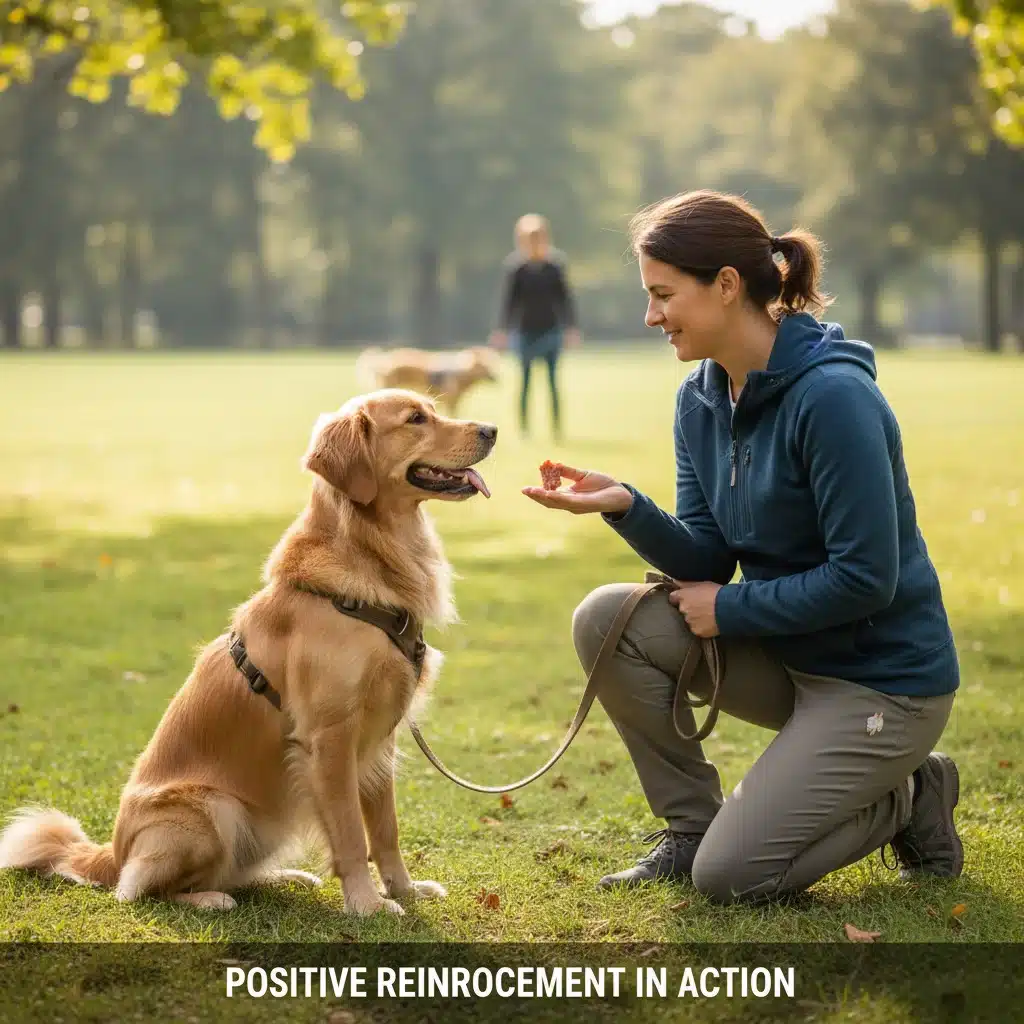
- Mark and Reward: The moment your dog notices the trigger (e.g., another dog) without reacting, say a marker word like ‘Yes!’ or use a clicker, and immediately give them a high-value treat.
- Repeat: Continue this pattern. Trigger appears → Dog notices calmly → Mark → Treat.
- Goal: The aim is for your dog to eventually look at the trigger and then immediately look back at you, anticipating a treat. This is often called the ‘Look At That’ (LAT) game. You’re essentially teaching them: ‘Other dog = delicious treat!’
- Gradual Approach: Over many sessions and days, as your dog consistently responds calmly, you can very gradually decrease the distance to the trigger. If your dog reacts, you’ve moved too close, too fast. Increase the distance again.
2. Engagement and Focus Exercises
Teaching your dog to focus on you, even with distractions, is vital for managing dog leash reactivity.
- Name Recognition: Practice calling your dog’s name in low-distraction environments, rewarding them generously when they look at you. Gradually add mild distractions.
- Watch Me/Look: Teach a ‘watch me’ or ‘look’ cue. Hold a treat to your nose, say ‘watch me,’ and reward when your dog makes eye contact. This is a powerful tool to redirect attention from triggers.
- Hand Target: Teach your dog to touch their nose to your open palm. This can be used as a ‘check-in’ and a way to move your dog away from a trigger.
Practice these exercises in various environments, starting with easy ones and slowly building up to more challenging scenarios (still below their reactivity threshold).
3. Emergency U-Turn/About-Turn
This is your escape route. If a trigger appears suddenly or gets too close, you need a reliable way to get your dog out of the situation quickly.
- Practice in a Quiet Area: With your dog on your left side, say a cue like ‘Let’s go!’ or ‘This way!’
- Pivot and Treat: Immediately turn 180 degrees, encouraging your dog to turn with you. As they turn, present a high-value treat at your side, rewarding them for moving with you.
- Build Speed: Practice this until it’s a fluid, quick movement. The goal is to make turning away from a trigger a positive, rewarding experience.
4. Parallel Walking (for dog-reactive dogs)
This technique is used when your dog is reactive to other dogs. It involves walking parallel to another dog and handler (a ‘helper dog’ who is calm and non-reactive), maintaining a significant distance where your dog remains calm. Both dogs walk in the same direction.
- Start Far Apart: Begin with enough distance so your dog is completely comfortable and can notice the other dog without reacting.
- Walk and Reward: As you walk parallel, periodically mark and reward your dog for calm behavior and for looking at the helper dog calmly, or for looking at you.
- Gradually Decrease Distance: Over many sessions, if both dogs remain calm, you can slowly, incrementally decrease the distance between them. This requires patience and consistency.
5. Relaxation and Decompression
Reactive dogs often live in a heightened state of arousal. Incorporate activities that promote relaxation:
- Sniffing Walks: Allow your dog to sniff extensively in low-distraction areas. Sniffing is naturally calming and mentally stimulating.
- Chewing and Licking: Provide appropriate chews (e.g., bully sticks, KONGs stuffed with frozen treats) at home. Chewing and licking are self-soothing behaviors.
- Calm Down Protocol: Teach your dog to settle on a mat or bed in various environments, starting at home.
Remember, consistency, patience, and positive reinforcement are key. Avoid punishment, as it only suppresses behavior temporarily and can worsen underlying fear or anxiety, making dog leash reactivity more ingrained.
Common Pitfalls to Avoid When Dealing with Leash Reactivity
Navigating the journey of modifying dog leash reactivity can be challenging, and it’s easy to fall into common traps that can hinder progress or even worsen the problem. Being aware of these pitfalls can help you stay on the right track.
1. Using Aversive Tools or Punishment
Pitfall: Relying on choke chains, prong collars, shock collars, or verbal/physical punishment to stop reactive behavior. Many owners resort to these out of desperation or misguided advice.
Why it’s harmful: These tools work by causing pain, fear, or discomfort. While they might temporarily suppress the reactive display, they do not address the underlying emotional cause (fear, frustration). In fact, they often exacerbate it. Your dog may associate the pain/fear with the trigger (e.g., ‘other dogs mean pain’), making them even more fearful and potentially leading to redirected aggression towards you or unprovoked bites. They also damage the trust between you and your dog.
2. Flooding or Forcing Interactions
Pitfall: Intentionally exposing your dog to triggers at close range, hoping they’ll ‘get over it,’ or forcing them into interactions with other dogs or people they are reactive towards.
Why it’s harmful: This is called ‘flooding’ and is highly detrimental. It overwhelms your dog, pushing them far past their threshold. Instead of learning to cope, they become more traumatized, fearful, and their reactivity often escalates. True desensitization and counter-conditioning require starting at a distance where the dog is comfortable and gradually decreasing it.
3. Inconsistency in Training and Management
Pitfall: Applying training techniques some days but not others, or allowing your dog to react frequently on walks without intervention.
Why it’s harmful: Dogs thrive on consistency. If reactive behavior is sometimes allowed or reinforced (even accidentally, by letting them pull you to a trigger), it confuses your dog and makes it harder for them to learn new, calmer responses. Every reaction reinforces the unwanted behavior. A consistent management and training plan is critical for success in modifying dog leash reactivity.
4. Not Using High-Value Enough Rewards
Pitfall: Using dry kibble or low-value treats when trying to distract or reward your dog in the presence of a strong trigger.
Why it’s harmful: When your dog is highly aroused or stressed by a trigger, a low-value treat simply won’t cut it. The distraction (the trigger) is far more compelling than the reward. You need treats that are so delicious and exciting that they can effectively compete with the trigger’s pull and create a strong positive association. If your dog ignores the treat, it’s not high-value enough or you’re too close to the trigger.
5. Expecting Overnight Miracles
Pitfall: Becoming frustrated or giving up because you don’t see immediate, dramatic changes in your dog’s behavior.
Why it’s harmful: Modifying dog leash reactivity is a marathon, not a sprint. It takes time, patience, and consistent effort. Your dog’s reactive behaviors have likely been practiced for a long time, and changing deep-seated emotional responses takes weeks, months, or even longer. Celebrate small victories and understand that setbacks are a normal part of the process.
6. Neglecting Your Own Stress
Pitfall: Allowing your own anxiety and stress about walks to transfer to your dog.
Why it’s harmful: Dogs are incredibly adept at picking up on our emotions. If you’re tense, gripping the leash tightly, or anticipating a reaction, your dog will sense this and likely become more anxious themselves, making them more prone to reactivity. Work on staying calm and confident yourself; your demeanor can significantly influence your dog’s behavior.
7. Not Seeking Professional Help When Needed
Pitfall: Trying to handle severe dog leash reactivity entirely on your own without expert guidance.
Why it’s harmful: While this guide provides a strong foundation, some cases of reactivity are complex and benefit greatly from the expertise of a certified professional dog trainer (CPDT-KA) or a veterinary behaviorist (DACVB). They can provide personalized plans, observe nuances you might miss, and offer hands-on guidance. Don’t hesitate to reach out for help if you feel overwhelmed or aren’t seeing progress.
Advanced Strategies and Long-Term Success with Leash Reactivity
Once you’ve mastered the basics of management and initial training, you can incorporate more advanced strategies to solidify your dog’s progress and ensure long-term success in overcoming dog leash reactivity.
1. Pattern Games and Predictability
Dogs thrive on predictability. Incorporate ‘pattern games’ into your walks. These are sequences of actions that become predictable and rewarding for your dog, helping them stay engaged with you even in distracting environments.
- ‘Engage-Disengage’: Similar to LAT, but more structured. When your dog sees a trigger, mark and reward. If they disengage and look at you, mark and reward again. The pattern becomes: Trigger → Look at Trigger → Look at Me → Treat.
- ‘1-2-3 Game’: Walk a few steps, stop, say ‘1-2-3,’ and give a treat. This builds anticipation and focus on you during movement.
- ‘Find It’: When a trigger is approaching, toss a handful of treats on the ground for your dog to sniff out. This engages their nose, distracts them, and provides a positive association with the trigger’s appearance.
These games create a positive routine that helps your dog anticipate good things when triggers appear, rather than reacting negatively.
2. Relaxation Protocols and Mat Work
Teaching your dog to relax on cue is invaluable. A ‘place’ or ‘mat’ command can be used at home and eventually in slightly distracting environments. The goal is to build a strong association between the mat and relaxation.
- Karen Overall’s Relaxation Protocol: A structured, progressive program that teaches your dog to settle calmly in various situations and with increasing distractions.
- Portable Mat: Once your dog is proficient at home, bring a small mat or towel on walks to designated ‘settle spots’ (e.g., a quiet bench at a park). Reward them for lying down and relaxing.
A dog that can relax on cue is better equipped to handle stressful situations, which directly impacts dog leash reactivity.
3. Building a ‘Default’ Check-In
Ideally, you want your dog to automatically look at you when they notice a trigger, without you having to ask. This is a ‘default’ behavior. To build this:
- Consistently reward your dog every time they spontaneously glance at you during a walk, especially when a potential distraction is present.
- Gradually, they will learn that looking at you in the presence of a trigger often leads to a reward, making it their go-to response.
4. Focus on Body Language
Learn to read your dog’s subtle body language cues. This will help you identify when they are starting to become uncomfortable or stressed, allowing you to intervene before a full-blown reaction occurs.
- Early warning signs: Stiffening, freezing, hard stare, whale eye (showing the whites of their eyes), lip licking, yawning (out of context), subtle ear movements, tail tucked slightly.
- Intervene early: If you see these signs, increase distance, redirect their attention, or perform an emergency U-turn. Don’t wait for the bark or lunge.
5. Incorporate Fun and Enrichment
Don’t let training for dog leash reactivity become a chore. Keep it fun and engaging for both of you. Incorporate games, sniff walks, and other enrichment activities that your dog enjoys. A happy, well-exercised, and mentally stimulated dog is generally less prone to reactivity.
6. Maintain a Realistic Perspective
While significant improvement is highly achievable, complete ‘cure’ for dog leash reactivity is not always realistic, especially for dogs with strong genetic predispositions or severe fear. The goal is often to manage it effectively, reduce the intensity and frequency of reactions, and ensure your dog can enjoy walks calmly and safely. Celebrate progress, no matter how small, and be prepared for occasional setbacks.
7. Consider Medication (Consult a Vet)
For some dogs with severe anxiety or fear-based reactivity, behavioral medication prescribed by a veterinary behaviorist or a general veterinarian can be a valuable aid. Medication doesn’t ‘fix’ the problem, but it can help lower your dog’s overall anxiety levels, making them more receptive to training and allowing them to learn more effectively. It’s often used in conjunction with a robust training plan.
Long-term success with dog leash reactivity is about consistent practice, patience, and a deep understanding of your dog’s needs. By building a strong foundation of trust and positive reinforcement, you can help your dog navigate the world with greater confidence and calm.
When to Seek Professional Help for Dog Leash Reactivity
While this guide provides a wealth of information and practical strategies, there are times when seeking professional help is not just beneficial, but essential. Dog leash reactivity can be a complex issue, and an expert can offer tailored guidance and support that might be difficult to achieve on your own.
1. If You’re Feeling Overwhelmed or Frustrated
Training a reactive dog can be emotionally draining. If you find yourself consistently frustrated, angry, or dreading walks, it’s a clear sign that you could benefit from professional support. A trainer can provide a fresh perspective, boost your confidence, and help you navigate challenging situations, making the process less stressful for both you and your dog.
2. If Your Dog’s Reactivity is Severe or Escalating
If your dog’s reactions are intense (e.g., continuous lunging, growling, snapping), or if their reactivity is worsening despite your efforts, it’s time to call in an expert. Severe reactivity, especially if it involves aggression, carries safety risks and requires specialized intervention.
3. If There’s a Risk of Injury
If your dog’s reactivity puts themselves, other dogs, or people at risk of injury, immediate professional help is paramount. This includes dogs who have bitten or attempted to bite during a reactive episode. Safety must always be the top priority.
4. If You’re Not Seeing Progress
You’ve been diligently applying the techniques, but your dog’s dog leash reactivity isn’t improving, or progress is minimal. A professional can assess your techniques, identify any subtle errors, and suggest alternative strategies or adjustments to your plan.
5. If You Suspect Underlying Medical Issues or Extreme Anxiety
As mentioned earlier, pain or extreme anxiety can contribute to reactivity. If you suspect a medical issue, consult your veterinarian first. If anxiety is severe and impacting your dog’s quality of life beyond walks, a veterinary behaviorist (a veterinarian specializing in animal behavior) can assess if medication is appropriate as part of a comprehensive treatment plan.
Who to Seek Help From:
- Certified Professional Dog Trainer (CPDT-KA, KPA CTP, or similar): Look for trainers who use positive reinforcement, force-free methods, and have experience specifically with dog leash reactivity. They can provide hands-on coaching and develop a personalized training plan.
- Certified Dog Behavior Consultant (CDBC): These professionals have extensive experience in addressing complex behavior problems and can offer deeper insights into the root causes of reactivity.
- Veterinary Behaviorist (DACVB): These are veterinarians with advanced training and board certification in animal behavior. They can diagnose and treat behavioral disorders, including prescribing medication when necessary, in conjunction with a behavior modification plan.
Avoid trainers who advocate for aversive methods, ‘dominance theory,’ or promise quick fixes. These approaches are often detrimental to your dog’s well-being and can worsen reactivity.
Remember, asking for help is a sign of responsible pet ownership, not a failure. A professional can be an invaluable partner in helping you and your dog overcome dog leash reactivity and enjoy a happier, calmer life together.
Conclusion: Embracing a Calmer Future with Your Dog
Living with a dog who exhibits dog leash reactivity can be profoundly challenging, impacting everything from your daily routine to your emotional well-being. However, it’s crucial to remember that reactivity is a learned behavior, often rooted in fear, frustration, or over-excitement, and it is almost always modifiable with the right approach.
This comprehensive 2026 guide has equipped you with the knowledge and practical strategies to understand, manage, and ultimately transform your dog’s leash reactivity. We’ve covered the importance of understanding the root causes, selecting appropriate, humane equipment, implementing effective management techniques to prevent rehearsals of unwanted behavior, and employing positive reinforcement training methods like counter-conditioning and desensitization.
The journey to a calmer dog is a marathon, not a sprint. It demands patience, consistency, empathy, and a commitment to positive reinforcement. There will be good days and challenging days, small victories and occasional setbacks. Celebrate every step forward, no matter how minor, and remember that each successful, non-reactive walk reinforces the positive changes you’re working so hard to achieve.
By investing your time and effort in these humane and effective techniques, you’re not just training your dog; you’re strengthening your bond, building their confidence, and fostering a deeper sense of trust. Imagine the joy of peaceful walks, the freedom of exploring new places together without dread, and the quiet satisfaction of knowing you’ve helped your best friend navigate the world with greater comfort and calm.
Embrace the process, stay consistent, and don’t hesitate to seek professional guidance when needed. A calmer, more enjoyable future for both you and your dog, free from the stress of dog leash reactivity, is well within reach. Happy walking!